Returns & price transforms
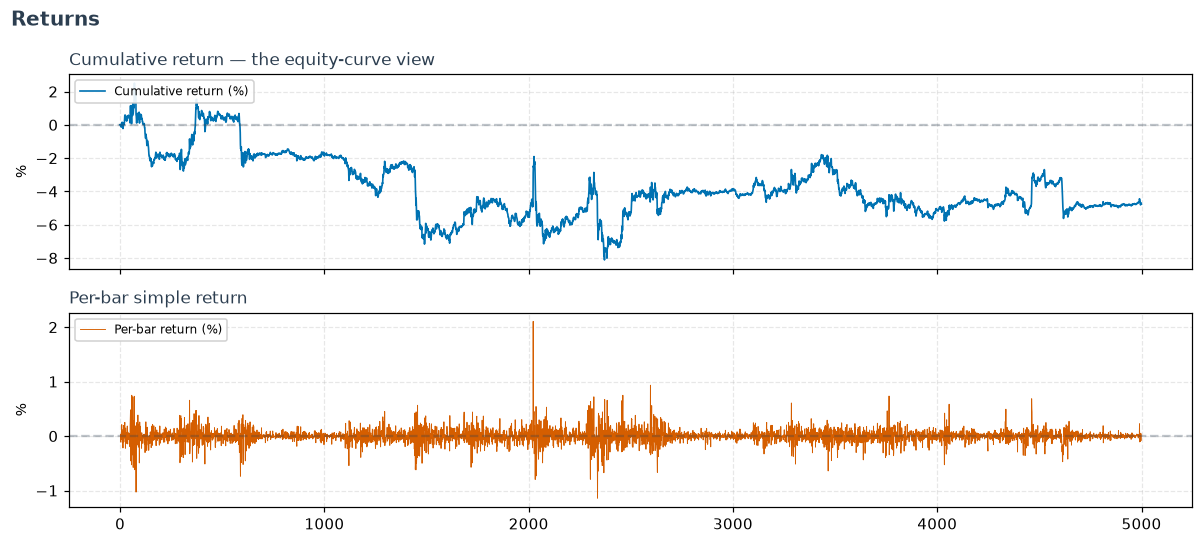
The plumbing every other calculation sits on: turning a price series into returns, and collapsing an OHLC bar into a single representative price. Small on purpose — but getting the convention right (percent vs. log, period vs. cumulative) matters, because everything downstream inherits it.
Returns
daily_return— simple percentage return bar-to-bar. Intuitive; what a P&L statement shows.daily_log_return— the log return. Log returns add up over time and are closer to normally distributed, which is why volatility and risk models are usually built on them.cumulative_return— total growth since the first bar; the equity-curve view.
Which return should I use?
Use log returns for anything statistical (volatility, correlation, factor models — they're time-additive), and simple returns when you need an actual P&L or want to compound across assets in a portfolio.
Price transforms
Four conventional ways to collapse the four OHLC columns into one price. Each
is a one-liner, but a named, conventional one-liner — and several indicators
are formally defined on one of them, so being able to say typical_price()
beats re-deriving (h + l + c) / 3 at every call site.
typical_price—(high + low + close) / 3. The standard summary, and the input CCI and the Money Flow Index are defined on. Start here.median_price—(high + low) / 2. The midpoint of the range, indifferent to where the bar opened or closed.weighted_close_price—(high + low + 2*close) / 4. Double-weights the close, on the view that where a bar settled says more than where it merely traded.average_price—(open + high + low + close) / 4. The only one that uses the open, so it reflects the whole bar.
All four take the conventional column names by default, so typical_price()
works on a standard OHLC frame with no arguments.
Return-based indicators and OHLC price transforms.
Two small families that are plumbing rather than signals:
- Returns — turning a price series into simple, log, or cumulative returns. Getting the convention right matters because everything downstream inherits it.
- Price transforms — collapsing the four OHLC columns into one
representative price. These are one-liners, but they are named, conventional
one-liners:
typical_priceis the input CCI and the Money Flow Index are defined on, so being able to name it directly keeps a pipeline readable instead of re-deriving(h + l + c) / 3at each call site.
daily_return(close: str | Expr, fillna: bool = False) -> Expr
Daily percentage return, in percent.
Source code in polars_ta/others.py
21 22 23 24 25 | |
daily_log_return(close: str | Expr, fillna: bool = False) -> Expr
Daily logarithmic return, in percent.
Source code in polars_ta/others.py
28 29 30 31 32 | |
cumulative_return(close: str | Expr, fillna: bool = False) -> Expr
Cumulative return since the first observation, in percent.
Source code in polars_ta/others.py
35 36 37 38 39 | |
average_price(open_: str | Expr = 'open', high: str | Expr = 'high', low: str | Expr = 'low', close: str | Expr = 'close') -> Expr
Average Price — (open + high + low + close) / 4.
The only transform that uses the open, so it is the one that reflects the whole bar rather than just its range and close.
Source code in polars_ta/others.py
53 54 55 56 57 58 59 60 61 62 63 64 65 66 67 68 69 70 | |
median_price(high: str | Expr = 'high', low: str | Expr = 'low') -> Expr
Median Price — (high + low) / 2, the midpoint of the bar's range.
Source code in polars_ta/others.py
73 74 75 76 77 78 | |
typical_price(high: str | Expr = 'high', low: str | Expr = 'low', close: str | Expr = 'close') -> Expr
Typical Price — (high + low + close) / 3.
The standard "one price per bar" summary, and the input CCI and the Money Flow Index are defined on.
Source code in polars_ta/others.py
81 82 83 84 85 86 87 88 89 90 91 92 | |
weighted_close_price(high: str | Expr = 'high', low: str | Expr = 'low', close: str | Expr = 'close') -> Expr
Weighted Close Price — (high + low + 2 * close) / 4.
Like typical_price but double-weighting
the close, on the view that where a bar settled says more than where it
traded.
Source code in polars_ta/others.py
95 96 97 98 99 100 101 102 103 104 105 106 107 | |